Horton Plains and World's End: Sri Lanka's Cloud Forest Walk
By Sahan Kalpa Dayarathna · · 5 min read
- Province
- Central Province, Nuwara Eliya District
- Altitude
- About 2,100 m above sea level
- Status
- UNESCO World Heritage Site, part of the Central Highlands
- The walk
- About 9 km, 3–4 hours, mostly flat with a steep section
- World's End
- A cliff edge with roughly an 870 m drop
- Best time
- January to March; start at opening
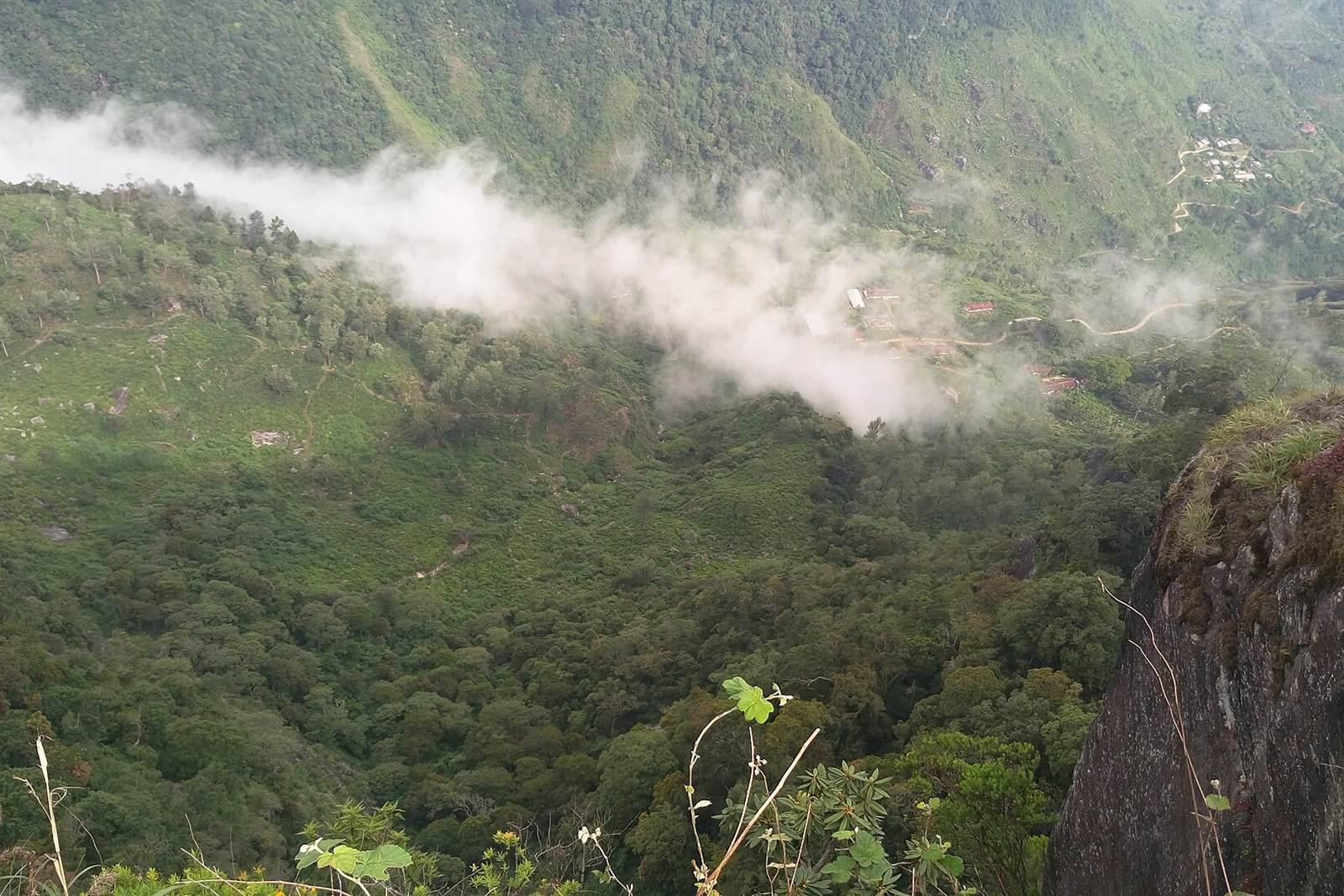
Horton Plains is a high, windswept plateau in the central highlands, protected as a national park and listed as part of the Central Highlands UNESCO World Heritage Site. At around 2,100 metres the landscape feels more like Scotland than the tropics: cloud forest, grassland, rhododendrons and sudden drops into mist.
The main reason people come is World's End, a cliff edge where the plateau falls away by roughly 870 metres. On a clear morning you can see across the southern plains almost to the coast. On a cloudy one — which is most of the time after about 9am — you see a white wall and the backs of other disappointed walkers.
Why the early start is not optional
The park gates open around 6am, and the first hour is the difference between a view and a wall of cloud. Moist air from the plains hits the escarpment and condenses as the ground warms, so the window between clear and socked-in is short. In the dry season it can last until mid-morning. In the wet season you might get twenty minutes.
That means leaving Nuwara Eliya in the dark, often around 4:45am to 5:15am, and driving for about an hour. It is not fun, and the coffee is bad, but it is the whole point. If you are staying in Ohiya or on the Haputale side, your journey is shorter.
Some visitors arrive at 9am and still see the view in the dry season. Treat that as luck rather than a plan.
The loop, step by step
The trail is a loop of roughly nine kilometres, and the park asks walkers to go clockwise. From the entrance, the path crosses grassland before reaching the first viewpoint, then continues through cloud forest to the main World's End viewpoint, with a smaller Mini World's End stop earlier on.
After World's End, the trail descends through forest to Baker's Falls, a cascade of about twenty metres, where there is a wooden viewing platform. The final stretch climbs gently back to the entrance through open grassland. The whole loop takes three to four hours at an easy pace, longer if you stop for photographs or wait for cloud to clear.
Do not shortcut back from World's End the way you came unless you have to. The full loop is the point, and the forest section between World's End and Baker's Falls is one of the quietest stretches of walking in the highlands.
- Mini World's End: a smaller viewpoint about halfway along the plateau edge
- World's End: the main cliff, with the best chance of a clear view early
- Baker's Falls: a shaded waterfall on the descent, with a viewing platform
- Cloud forest: dwarf trees, moss and endemic birds on the return leg
Wildlife and what you might see
Sambar deer graze on the grassland and are often visible near the trail, sometimes uncomfortably close to the car park. The park is also home to the Sri Lanka white-eye, the dull-blue flycatcher and a long list of highland endemics that will interest birders more than casual walkers.
The vegetation changes abruptly from grassland to cloud forest, and the dwarf trees near the plateau edge are adapted to wind and cold. Do not feed the animals, keep your distance from the deer, and stay on the marked path. The plateau is a fragile environment with thin soil and slow-growing plants.
Tickets, transport and the practical bits
Foreign visitors pay a national park entrance fee, and the rate changes from time to time. There is a ticket office at the entrance, and the queue can be long at opening. Having a driver or guide who knows the process helps, but it is not essential. Confirm the current fee and opening time before you commit to a very early start.
Most visitors reach the park by tuk-tuk or jeep from Nuwara Eliya, about an hour away, or from Ohiya on the railway line. The road is narrow and misty in the early morning, so a local driver is worth the money. There is no reliable food or water inside the park.
Single-use plastic is restricted, and there are no shops, so decant what you need before you arrive. Wear layers, including a waterproof shell, and shoes with grip. The trail can be muddy and slippery, and leeches are common in the wetter months.
Walking responsibly
Stay on the marked path. The plateau edge is unstable in places, and people have fallen at World's End. Do not climb over the barriers for a photograph, and do not sit on the edge.
Carry out everything you bring in. Litter is a visible problem at the busiest viewpoints, and the park has limited facilities. If you hire a guide, agree the fee in advance and confirm they are authorised to accompany visitors.
The altitude makes the walking feel harder than the distance suggests. Give yourself more time than you think you need, and do not plan a long drive immediately afterwards. Most people are back in Nuwara Eliya by lunchtime, ready for tea and a nap.
Frequently asked questions
- What time should I arrive at Horton Plains?
- At opening, around 6am. Cloud usually builds by mid-morning and can hide World's End completely. That means leaving Nuwara Eliya around 5am.
- How difficult is the Horton Plains walk?
- It is moderate: about 9 km on mostly flat ground, with one rougher section near World's End and a descent to Baker's Falls. The altitude makes it feel harder than the distance suggests, so allow three to four hours.
- Is Horton Plains worth it if it is cloudy?
- The walk is still pleasant in cloud — the forest section is atmospheric and the wildlife does not mind. But if the view from World's End is the main reason you are going, go early and accept that the weather decides.
- Can I visit Horton Plains without a guide?
- Yes, the trail is well marked and a guide is not required. A driver is useful for the early-morning transfer, and a guide adds context if you are interested in the ecology.
Written by
Sahan Kalpa DayarathnaSahan Kalpa Dayarathna is the editor of Discover Sri Lanka, based in Colombo. He writes the province guides, hotel picks and practical travel advice on this site, and updates them as transport, prices and opening times change.
Story filed 9 March 2026 about Horton Plains. Explore more in Central Province.
More traveller stories
16 February 2026
Sigiriya Rock Fortress: A Practical Guide to Climbing Lion Rock
Tickets, timing, the frescoes and the climb — what to expect at Sri Lanka's most famous rock fortress, plus the quieter view from Pidurangala.
23 February 2026
Temple of the Tooth: Inside Kandy's Sacred Relic Shrine
Sri Lanka's most important Buddhist temple, the three daily pujas and the rituals around a single tooth.