Galle Fort: A Walking Guide to Sri Lanka's Walled City
By Sahan Kalpa Dayarathna · · 6 min read
- Province
- Southern Province, Galle District
- First fortified
- By the Portuguese in 1588
- Dutch walls
- Most of what you see dates from the 17th century
- UNESCO
- Listed in 1988 as Old Town of Galle and its Fortifications
- Rampart loop
- About 2.5 km on foot; 2–3 hours with stops
- Best time
- Early morning or the last two hours of daylight
Galle Fort is the rare heritage site that still works as a neighbourhood. The Portuguese built the first fort here in 1588, the Dutch turned it into the star-shaped walled town you see today, and the British added their own layer before independence. Inside the ramparts, Dutch-era villas, a Dutch Reformed church, mosques, law courts and small shops sit along streets that are narrow, hot and best explored on foot.
The fort covers only about 52 hectares, so you can cross it in twenty minutes and still spend a full day. That is the trick of the place: the headline sights take an hour, and everything else — the doorways, the courtyards, the fishermen on the rocks, the schoolchildren in white — rewards slowing down.
Four centuries in one small town
The Portuguese arrived in the sixteenth century and built a modest fort around the harbour. The Dutch took it in 1640 and rebuilt it properly, laying out the grid of streets, the ramparts, the canals and the churches that still define the town. The British, who took control in 1796, added the clock tower, the lighthouse and a good deal of administrative brickwork.
What makes Galle unusual is that the walls were never demolished. The old town kept its shape, and people kept living in it. UNESCO listed it in 1988, and restoration since then has been uneven — some buildings are beautifully conserved, others are held together by paint and hope — but the overall effect is a working town inside a monument rather than a museum inside a wall.
The rampart walk
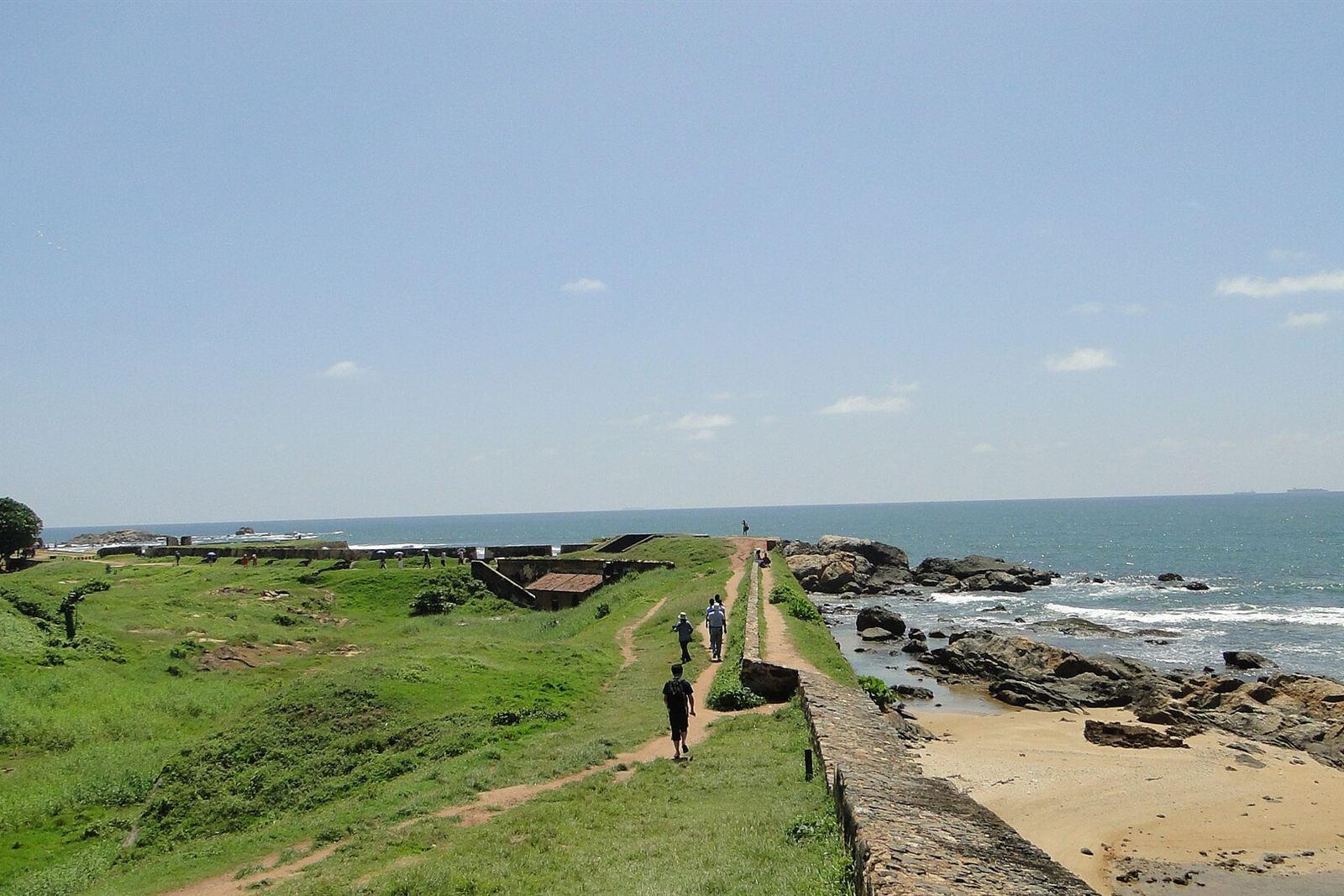
Start at the Main Gate on the landward side and walk anticlockwise along the top of the walls. The circuit is about 2.5 kilometres and takes an hour without stops, but you will stop constantly. The first stretch passes the clock tower and the old administrative buildings, then opens onto the sea.
The southern ramparts are the widest and the most popular at sunset, when families, couples and groups of friends spread out along the grass with snacks and cameras. Continue west to Flag Rock, the southernmost point of the fort, where fishermen balance on the rocks below and the swell breaks against the wall. The lighthouse stands on the western rampart, white and slightly absurd against the grey stone; it is not usually open to climb.
Walk the walls at sunrise and you will have them almost to yourself, with the light coming in from the east and the town still quiet. Walk them at sunset and you get the social life of Galle in one long, slow promenade. Both are worth doing if you stay a night.
- Main Gate and clock tower: the easiest entry point and the start of the circuit
- Flag Rock: the southern tip, best at sunset, with fishermen below the wall
- Lighthouse: the photogenic white tower on the western rampart
- Old Dutch Hospital: a restored courtyard of shops and restaurants
- Dutch Reformed Church: a 1755 church with a gravestone floor
Inside the walls
Church Street runs through the middle of the old town and holds most of the landmarks in a short stretch: the Dutch Reformed Church, the Meeran Jumma Mosque, the old Dutch Hospital and a row of shops selling gemstones, spices and the kind of linen clothing that looks better in a photograph than in a suitcase.
The Dutch Reformed Church, built in 1755, is cool and plain inside, with a floor made of engraved Dutch gravestones and a pulpit of calamander wood. The Meeran Jumma Mosque, further along, is a white wedding-cake of a building that is still an active place of worship — dress respectfully and avoid prayer times if you want to look inside. The maritime museum near the Main Gate is small and dated but does a decent job of explaining the harbour's history, and the law courts and the old Dutch governor's residence are worth a glance from the street.
The side lanes are where the fort becomes memorable. Rampart Street, Leyn Baan Street and Pedlar Street are lined with restored villas, small hotels and cafés that spill onto the pavement. Look up: the Dutch-style verandas, the curved tiles and the carved doorways are the real architecture, and many are attached to ordinary houses rather than hotels.
Where to eat, drink and sleep
The fort has some of the south coast's best cooking, from rice and curry in a family-run café to polished seafood dinners in a courtyard. The Old Dutch Hospital is the easiest place to start if you want several options in one building, but the better meals are usually in the smaller lanes, where a handful of tables and a handwritten menu are a good sign rather than a warning.
Staying inside the walls costs more than staying on the nearby beaches, but it buys you the old town at its best: early morning before the day-trippers arrive, and late evening after the last bus has gone. Book ahead from December to April and around local holidays. If you are on a tighter budget, look at the guesthouses just outside the walls or in nearby Unawatuna and Dalawella, and come into the fort for the evening.
For coffee and air conditioning, the cafés around Pedlar Street are reliable. For a sundowner, the bars along the western rampart have the view but charge for it. For a proper Sri Lankan breakfast, walk out of the Main Gate and find a hopper stall before 9am.
Getting there, and what to know before you go
Galle is about 120 kilometres from Colombo. The Southern Expressway cuts the drive to around an hour and a half in good traffic, and the coastal train takes roughly two to two and a half hours from Colombo Fort, with the last stretch running beside the sea. The station is just outside the fort, a short tuk-tuk ride or a ten-minute walk from the Main Gate.
There is no safe swimming from the fort itself — the ramparts drop straight into a working harbour and a rocky shore. Unawatuna, Dalawella and Jungle Beach are all within fifteen to twenty minutes by tuk-tuk, and the beaches east towards Weligama are an easy day trip. If you want to swim, plan for that rather than hoping for a beach inside the walls.
Remember that this is a residential neighbourhood. Keep the noise down in the lanes after dark, ask before photographing people or doorways, and dress a little more modestly than you would on the beach. Entry to the fort is free; individual museums and the lighthouse charge or restrict access. One full day is enough for the highlights, but two nights is the right amount to see the town change character morning and evening.
Frequently asked questions
- How long do you need in Galle Fort?
- Half a day covers the ramparts and the main streets. A full day lets you add a museum, a long lunch and a second walk at sunset. Staying one or two nights is better still, because the fort is at its best before the tour buses arrive and after they leave.
- Is Galle Fort free to visit?
- Yes. Walking through the gates, along the streets and around the ramparts costs nothing. The maritime museum and some other small sites charge an entrance fee, and the lighthouse is generally not open to the public.
- Can you swim at Galle Fort?
- No. The fort sits on a rocky headland with a working harbour, and there is no safe beach inside the walls. Unawatuna, Dalawella and Jungle Beach are a short tuk-tuk ride away and are the places to swim.
- What is the best time to walk the ramparts?
- The last hour before sunset is the most popular, when locals come out and the light softens. Early morning is quieter and cooler, and better for photographs of the streets before the shops open.
Written by
Sahan Kalpa DayarathnaSahan Kalpa Dayarathna is the editor of Discover Sri Lanka, based in Colombo. He writes the province guides, hotel picks and practical travel advice on this site, and updates them as transport, prices and opening times change.
Story filed 16 March 2026 about Galle Fort. Explore more in Southern Province.
More traveller stories
4 May 2026
Yala National Park: Leopards, Safaris and What to Actually Expect
How a Yala safari works, when the leopards are easiest to see, which block to choose and why the crowds matter.
23 March 2026
Whale Watching in Mirissa: Blue Whales, Early Boats and Rough Seas
What a Mirissa whale-watching morning is really like, when the season runs and how to pick a boat worth boarding.