- Province
- Uva Province, Badulla District
- Height
- About 64 m
- Location
- About 5 km from Badulla
- Walk
- About 1 km each way, with steps down and a steady climb back
- Swimming
- Not permitted — strong current and slippery rocks
- Time needed
- One to one and a half hours round trip
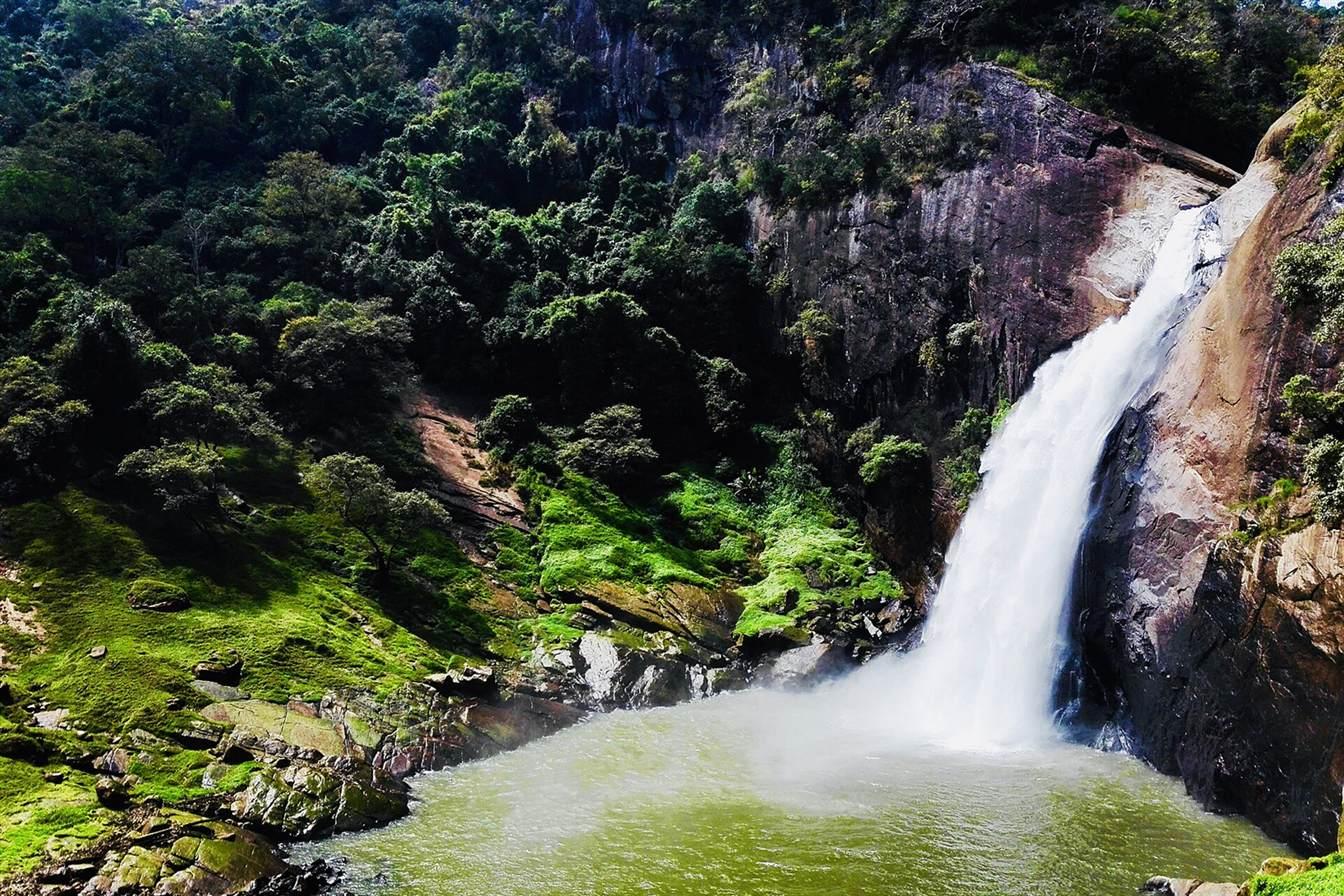
Dunhinda Falls drops around sixty-four metres into a rocky gorge about five kilometres from Badulla, the capital of Uva Province. The name means "smoky" or "misty" fall, and on a good day the spray rises from the pool in a cloud that gives the water its bridal-veil look. It is one of the island's best-known waterfalls and a popular local picnic spot.
It is not a roadside waterfall. Reaching it takes a walk, and the walk is part of the experience: a shaded path through trees, past stalls selling snacks and carved wooden souvenirs, with the sound of water getting louder.
The walk down
From the entrance, the path runs about a kilometre through forest, with a series of steps down towards the gorge. It is not difficult, but the return climb is steady and can be hot.
Wear shoes with grip. The path is damp even in the dry season, and the steps near the bottom are slick with spray. Allow an hour to ninety minutes for the round trip, more if you stop often.
Monkeys and vendors are both common along the route. Keep food out of sight, do not feed the monkeys, and agree prices before buying anything.
At the falls
The viewpoint at the base gives a full view of the cascade and the pool, with spray drifting across the rocks. It is genuinely impressive after rain, when the water is brown with sediment and the noise is constant.
Do not swim in the pool. The current is strong, the rocks are slippery and accidents have happened. Enjoy the view from the designated areas and keep children close.
After heavy rain the falls are at their most powerful, but the path is also wet and muddy, so take extra care. In the dry season the flow is thinner but the walking is easier.
- Stay behind the barriers at the base
- Do not swim in the pool
- Keep children close and hold the handrail
- Carry water for the climb back
Badulla and the surrounding area
Badulla makes a convenient base, with the Muthiyangana temple and the old town within easy reach. It is a pleasant, workaday town with a few colonial buildings and a good market.
It is also the terminus of the hill-country railway, which makes it a useful base for exploring the surrounding tea country. The journey from Ella to Badulla is short but scenic, with the line curving through tea estates.
If you have time, continue to the nearby Bogoda wooden bridge, one of the oldest covered bridges in Sri Lanka. It pairs neatly with a waterfall morning and is rarely crowded.
When to go
December to March is the driest season, though the waterfall is worth seeing year-round. The falls are at their fullest after the monsoon, when the water is powerful and the spray carries across the gorge.
Weekends and public holidays bring local families and music, which is lively but not peaceful. Weekday mornings are quieter and cooler.
The falls are a short tuk-tuk ride from Badulla and combine well with a trip to Ella or the Nine Arch Bridge. It is a fine introduction to the wet, green heart of the Uva Province.
What to wear and carry
This is a short walk with a lot of steps, so treat it like one. Shoes with tread are the single most useful thing you can bring; flip-flops on wet stone steps are how people end up limping back to Badulla.
A light rain jacket is worth carrying even on a dry morning, because the spray reaches the lower viewpoint and the forest holds moisture. A dry bag or plastic sleeve for your phone is cheap insurance.
Carry water for the climb back, and a little cash for the stalls. There are no proper toilets at the falls, so use the facilities near the entrance before you set off.
The Bogoda wooden bridge
About half an hour from Badulla, the Bogoda bridge is one of the oldest surviving covered wooden bridges in Sri Lanka. It was built in the sixteenth century to connect two villages across the Gallanda Oya, and it still stands under a tiled roof.
The bridge is small, quiet and easy to miss, which is part of its charm. Combine it with the falls for a morning that mixes scenery with something genuinely old. Ask a tuk-tuk driver to take you to both; the roads are narrow but short.
Nearby, the Bogoda cave temple has faded murals and a peaceful setting. It is not a major site, and that is precisely why it is worth an hour.
Frequently asked questions
- Can you swim at Dunhinda Falls?
- No. The current is strong, the rocks are slippery and accidents have happened. View the falls from the designated areas only.
- How long is the walk to Dunhinda Falls?
- About a kilometre each way, with steps down to the gorge and a steady climb back. Allow one to one and a half hours for the round trip.
- How far is Dunhinda Falls from Badulla?
- About five kilometres, or fifteen minutes by tuk-tuk. It is an easy half-day trip from the town.
- When is the best time to see Dunhinda Falls?
- After the monsoon, when the water is full and the spray is dramatic. December to March is drier and easier for walking, but the flow is thinner.
Written by
Sahan Kalpa DayarathnaSahan Kalpa Dayarathna is the editor of Discover Sri Lanka, based in Colombo. He writes the province guides, hotel picks and practical travel advice on this site, and updates them as transport, prices and opening times change.
Story filed 1 June 2026 about Dunhinda Falls. Explore more in Uva Province.
More traveller stories
11 May 2026
Nine Arch Bridge: Ella's Jungle Viaduct, and How to See It Properly
Where to stand, how to walk there, when the trains actually cross and why the bridge exists in the first place.
18 May 2026
Ravana Falls: Ella's Roadside Waterfall and the Legend Behind It
A tall cascade beside the Ella–Wellawaya road, tied to the Ramayana and best seen after the rains.